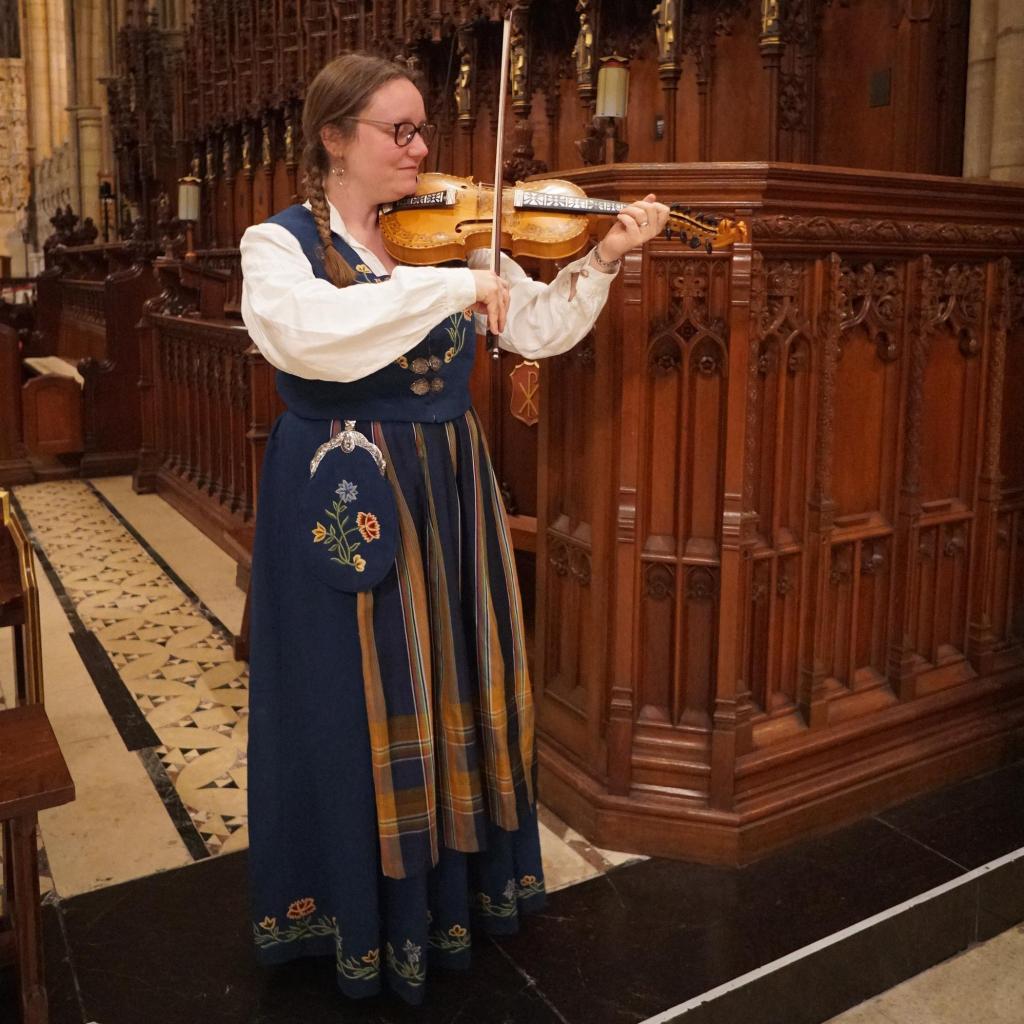
The Hardanger fiddle, or hardingfele, is a modified form of the violin, originating in the Hardanger region of Norway. In addition to the four “melody strings” (similar to violin strings), there are also a number of “sympathetic strings” that run under the fingerboard of the instrument, picking up the overtones from the melody strings and creating their own overtones and resonances. The instrument features heavily in Norwegian folklore and is often used in film soundtracks around the world.
Lottie began her musical journey as a violinist at the age of 4, and continued her studies at Cambridge University, where she played a number of solo concertos and recitals and was an active member of several university orchestras. She received a Hardanger fiddle for her 18th birthday and wrote her undergraduate dissertation on the place of the instrument in modern-day Norway and the wider world. As a player she has trained with a number of high-profile fiddlers at Scandimoot and also privately with Vegar Vardal. She continues to play the vanlegfele (“ordinary fiddle”) both as a folk fiddler (focusing on Scandinavian music) and as a classical violinist.
Lottie has played her Hardanger fiddle for a number of Scandinavian-themed corporate dinners, most notably for the Worshipful Company of Entrepreneurs and the Worshipful Company of World Traders. She has also given a number of Scandinavian folk concerts, including at St Paul’s Church Bedford, Clare College Cambridge, Brunel University and Wolfson College Cambridge. She received critical acclaim for her performances as Hardanger Fiddle and vocal soloist on Erland Cooper’s triptych of Orkney-inspired albums, Solan Goose, Sule Skerry and Hether Blether. Recently she was honoured to play the Hardanger fiddle solos in Edvard Grieg’s incidental music to Peer Gynt with Truro Choral Society.
 Lottie Greenhow